How a 38% budget cut and a two-word mandate became a new model for pipeline development
Role: Strategic Lead, Program Designer, and Cross-Functional Partner
Timeline: 2025-2026
Core Skills: Market segmentation, audience strategy, data-driven decision-making, change management, resource optimization, cross-functional leadership, pipeline development
The Opportunity
In the summer of 2025, nearly everything about my operating environment changed at once.
The university’s president stepped down. An interim president took over. We already had an interim provost. Over the course of the year, five or more deans would also depart. A reorganization moved me onto a newly created team under new leadership. My budget was cut from $650,000 to $400,000 — a 38% reduction — with the expectation that I’d deliver at the same level. I had no KPIs and almost no guidance. My mandate was two words: drive pipeline.
For most of my time at Emory, the mandate had been clear: big events designed to maximize attendance and reinforce the institutional brand. Open the doors, invite everyone, fill the room. When the organizational priorities shifted, so did the mandate — from broad reach to targeted engagement, specifically reaching the people with the capacity to make significant commitments who, for whatever reason, weren’t showing up.
Some of them had never engaged with us at all. Others had been on our radar for years but had ignored every outreach attempt. Either way, the traditional approach wasn’t reaching them. I needed to build something new.
I started with a question that seems obvious in retrospect but that nobody had formally asked: Where do these people actually live, and what would make them show up?
The previous model had been designed for broad audiences, which meant programming in predictable, central locations — midtown Manhattan, downtown Chicago, the usual. But when the target shifted to a specific, high-capacity audience, those locations didn’t always make sense anymore. The people we needed to reach weren’t necessarily going to trek across a city for an evening event. Sometimes the smartest strategic move was an incremental one: shifting a program from the center of a market to the neighborhood where the right people actually lived and worked.
The Approach
Building the Intelligence Layer
Before I designed a single event, I partnered with our data analytics team to build a dashboard that gave me a clear picture of every market in the country.
For each city, we could see how many constituents with the capacity for a six-figure commitment lived there. We could segment by age, wealth capacity, school affiliation, and more. And critically, the dashboard included heat maps showing where people lived and where they worked — two separate views — so I could choose venues that were genuinely convenient rather than aspirational.
That data drove most of my decision-making. But not all of it. I’d spent four years traveling these markets and had developed an instinct for what the numbers couldn’t tell me. One of our smaller markets, for example, had always produced strong turnout and high-capacity attendees despite its modest size on paper. I also knew we had a deeply engaged board member there who would serve as the face of the event and personally help drive attendance. The data didn’t flag that market as a priority. My judgment did. The process was a mix of art and science.
Designing Programs People Couldn’t Say No To
I produced twelve events in twelve cities over the course of eight months — two in the fall and ten in the spring, including a stretch of seven events in seven cities in a single month.
Every program was built around two principles: make it convenient and make it interesting.
On proximity: in one market notorious for low engagement because people simply don’t want to drive outside their neighborhood, I chose a venue inside a luxury residential building. Several of our highest-value prospects lived in the residences above. They could take the elevator down. They told me afterward they wouldn’t have come if it had been anywhere else.
In another city, I chose a favorite local restaurant directly across the street from the commuter rail station. It worked. Someone attended their first event in years simply because we’d finally gone to his neighborhood.
In another, I secured a rooftop in the middle of Beverly Hills. Attendees asked how I’d found it — their favorite restaurant, and they couldn’t believe someone who wasn’t from the city had chosen it. The answer is that my team and I spend significant time every year staying on top of the best restaurants, private clubs, and distinctive venues in every market we serve. To borrow a phrase from Taylor Swift: none of it was accidental.
On content: I matched speakers and topics to each market’s personality. In Boston, where the audience skewed toward healthcare and science professionals, I brought in a nationally recognized sleep researcher. Everyone wants to know why they’re tired — it was an instant draw. In Houston, I designed a panel so well-timed and well-matched to the city that it became something much bigger than a single evening — but more on that in a moment.
Over four years of traveling these markets, I’d developed a deep understanding of each city’s personality and audience. I also worked closely with regional colleagues on the ground who could tell me what people were talking about, what they cared about, and what would get them out of the house.
Scaling Beyond the Room
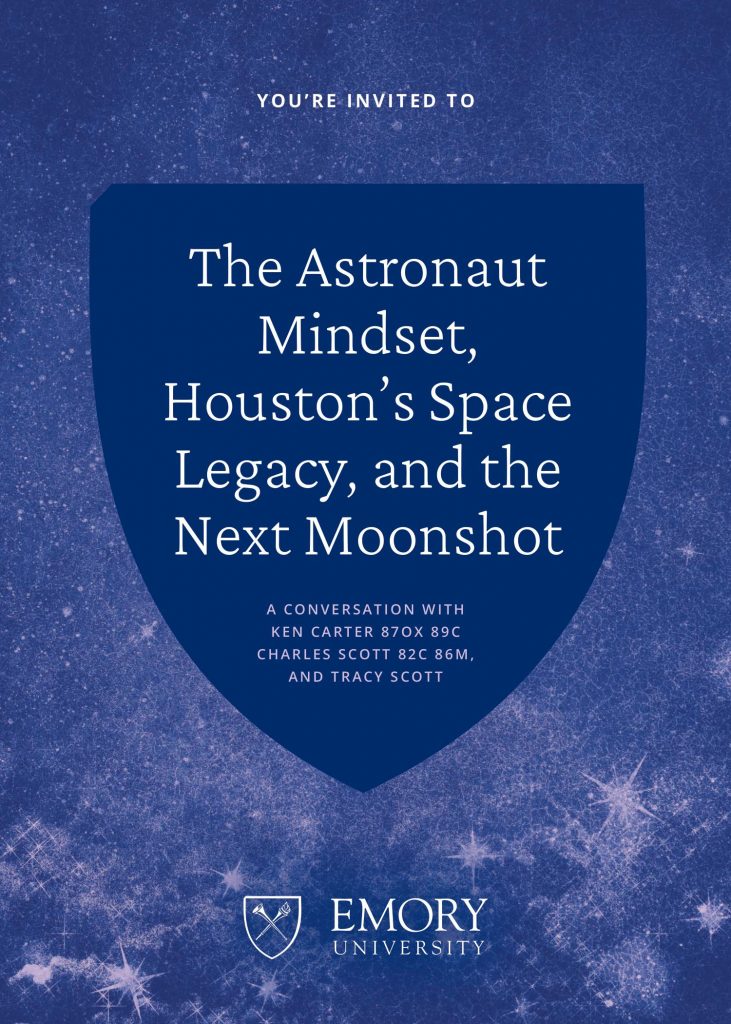
In Houston, I saw an opportunity to do something bigger than a single evening. In the weeks after the release of the movie Project Hail Mary and the completion of the historic Artemis II NASA mission, I designed a panel called Emory Together: The Astronaut’s Mindset, Houston’s Space Legacy, and the Next Moonshot, featuring a professor whose parent had walked on the moon and an alumni psychologist who consults on final astronaut selection for NASA. I scheduled it for May 4th. Yes, on purpose.
The timing and the topic were a slam dunk in Houston, and the evening was electric. But I also recognized that a conversation this compelling shouldn’t be limited to the people who happened to be in one room on one night. So I used remaining budget to professionally record the panel — something we hadn’t done at any other event that year.
A month later, I produced a international livestream re-airing of the recorded conversation, followed by a live virtual Q&A with one of the panelists that I moderated. The original event had been designed for a single market — now I opened it up to high-capacity prospects across the country, as well as a second chance for those in Houston who hadn’t been able to attend in person. A hundred and twenty-seven people joined, including members of the university’s board of trustees. A single evening in one city became a national engagement moment at virtually no additional cost.
From there, I distributed the recorded panel to the same national audience as gated, on-demand content — removing the scheduling barrier entirely while capturing viewer information that fed directly back into the prospect research and pipeline development process. And the content continues to work: the video now lives as a long-term marketing tool that the communications team can deploy whenever the topic resurfaces in the national conversation, turning a single evening’s investment into a lead-generating asset with a multi-year shelf life.
Changing the Message
The marketing team’s standard playbook leaned on a reliable phrase: reconnect with fellow alumni. I asked the team to move away from it, for several reasons.
Many of the people we were trying to reach had never been connected in the first place. Others associated that kind of language with a very different type of event — casual, youthful, social — when what I was producing was intentionally elevated. We were also inviting constituents beyond alumni — affiliates of the health system, parents, community members — for whom “reconnect with fellow alumni” was meaningless.
The reframe: meet interesting people doing important work. That spoke to where our audience was now, not where they’d been twenty years ago. It signaled that these events were worth their time in a way that transcended institutional loyalty.
The Outcome
The results validated the strategy at every level.
Over the course of the year, more than 600 people attended programming across twelve markets, with an average of roughly 50 per event — consistently meeting attendance targets. More than 200 new prospects were assigned to relationship managers’ portfolios as a direct result of the programming, creating a pipeline that hadn’t existed before.
Three stories capture the impact:
The discovery. In one market, a prospect attended his first event in years because the venue was in his neighborhood. His RSVP triggered a research review that revealed significant capacity. He was assigned to a relationship manager, who met him at the event, had coffee with him weeks later, and within a short period he had committed to endow a scholarship. The entire arc — from RSVP to signed agreement — happened in a couple of months, simply because we went to him.
The conversion. Across multiple markets, people who had ignored direct outreach for years showed up because the experience was compelling enough to override their resistance. They expected to be asked for something. Instead, they had a great evening, met interesting people, and discovered that the relationship managers they’d been avoiding were people they actually wanted to talk to. Walls came down in a single night that years of emails and phone calls hadn’t been able to breach.
The revelation. At one event, a conversation between an attendee and a senior leader revealed that the attendee had already made a significant six-figure planned gift that the organization had no record of. Without the event, that commitment would have remained invisible indefinitely. All we had to do was document what he’d already done.
To date, more than $300,000 in commitments have been finalized as a direct result of this programming — a remarkable figure given the typically long timeline between initial engagement and signed agreement.
All of this was accomplished with a three-person team — myself and two direct reports — on a budget 38% smaller than the previous year’s. We came in under budget.
The Most Meaningful Part
This year was the clearest proof of something I’ve experienced across my entire career: I do my strongest work when I’m given a hard problem, limited resources, and the room to figure it out.
No roadmap. No KPIs. No playbook. A 38% budget cut, a three-person team, and an organization in the middle of a leadership transition. From that starting position, I built an engagement model that identified over 200 new prospects, generated more than $300,000 in commitments in a fraction of the typical timeline, and turned a single recorded conversation into a gated, nationally distributed content asset with a multi-year shelf life.
I made decisions grounded in data when the data was clear and in judgment when it wasn’t. I designed experiences so tailored to each market that people asked how I knew what their favorite restaurant was. And I proved that fewer programs in smaller rooms, designed for the right audience, can sometimes move the needle just as much as a packed ballroom.
The best strategy doesn’t require a big budget or perfect conditions. It requires knowing your audience, having the confidence to go to them, and building something they can’t say no to.
Key Takeaways
This year didn’t come with a big budget, a detailed mandate, or a predictable organizational structure. It came with a hard problem and the opportunity to solve it. Here’s what I took away:
- Go to your audience. The most valuable people aren’t the ones who show up on their own. Meeting them in their neighborhoods, at their favorite restaurants, near their train stations — that’s what closed the gap.
- Constraints sharpen strategy. A 38% budget cut and minimal guidance forced a level of precision that a bigger budget might have allowed me to avoid. Fewer programs, smaller rooms, better outcomes.
- Data informs. Judgment decides. The dashboard told me where the opportunity was. Four years of market knowledge told me where it was hiding.
- Create the conditions, not the ask. People resist being sold to. They don’t resist a great evening. The programs succeeded because they gave people a reason to show up that had nothing to do with being asked for anything.